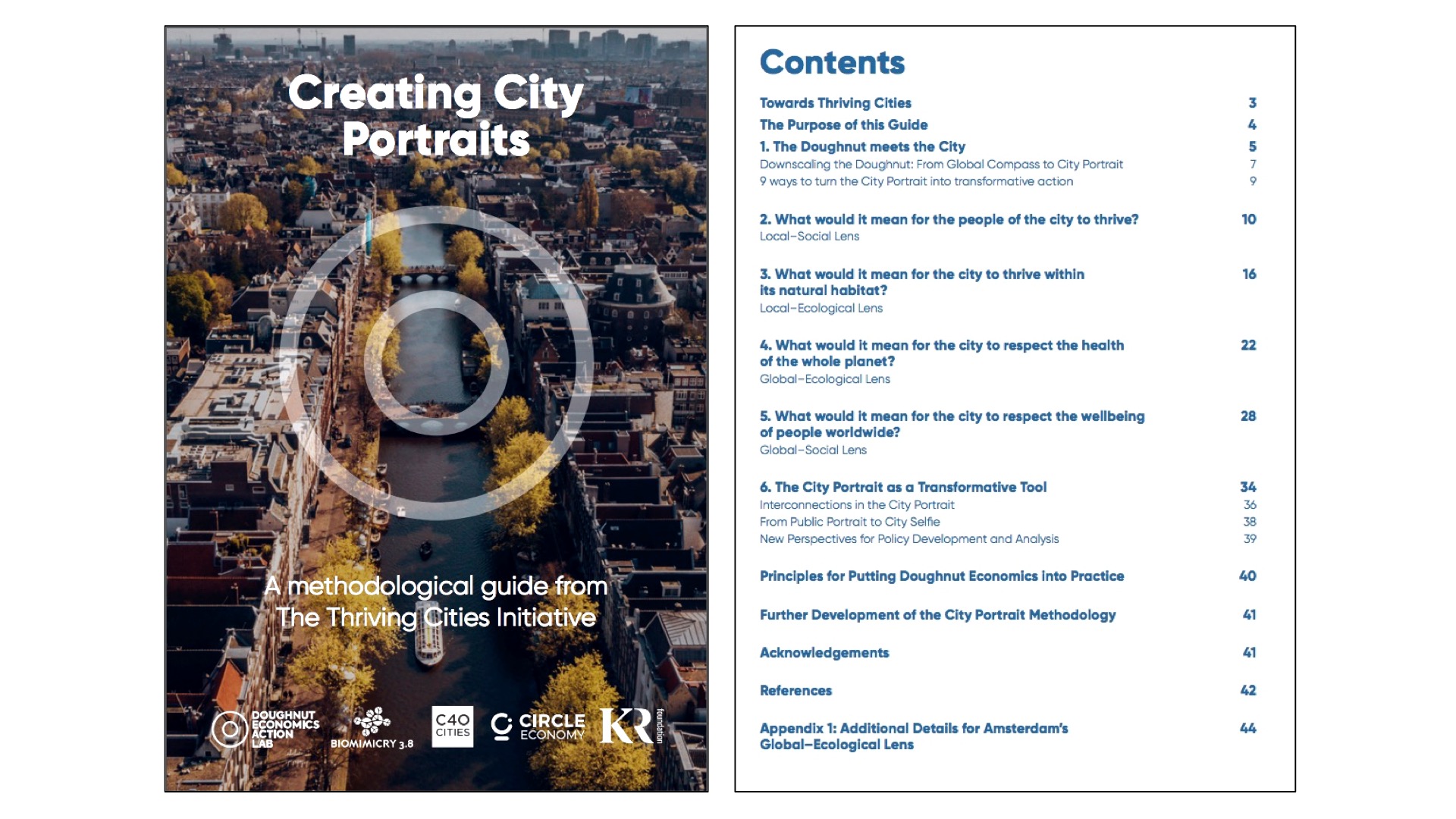
Today is the launch of Creating City Portraits – a methodological guide for downscaling the Doughnut to the city and turning it into a tool for transformative action.
The Doughnut is a compass for 21st century thriving – one that aims to meet the needs of all people within the means of the living planet. It’s drawn at a global scale, and ever since it was first published in 2012 people have sought ways to downscale it.
Over the past year, we at Doughnut Economics Action Lab have collaborated with Biomimicry 3.8, C40 Cities and Circle Economy – through the Thriving Cities Initiative – to downscale the Doughnut to the scale of the city. In 2019 we piloted the approach in three cities of the global North: Philadelphia, Portland and Amsterdam. In April 2020, Amsterdam published the Amsterdam City Doughnut and adopted it as a vision and model for shaping the future of the city.
The City Portrait invites every city to ask itself this very 21st century question:
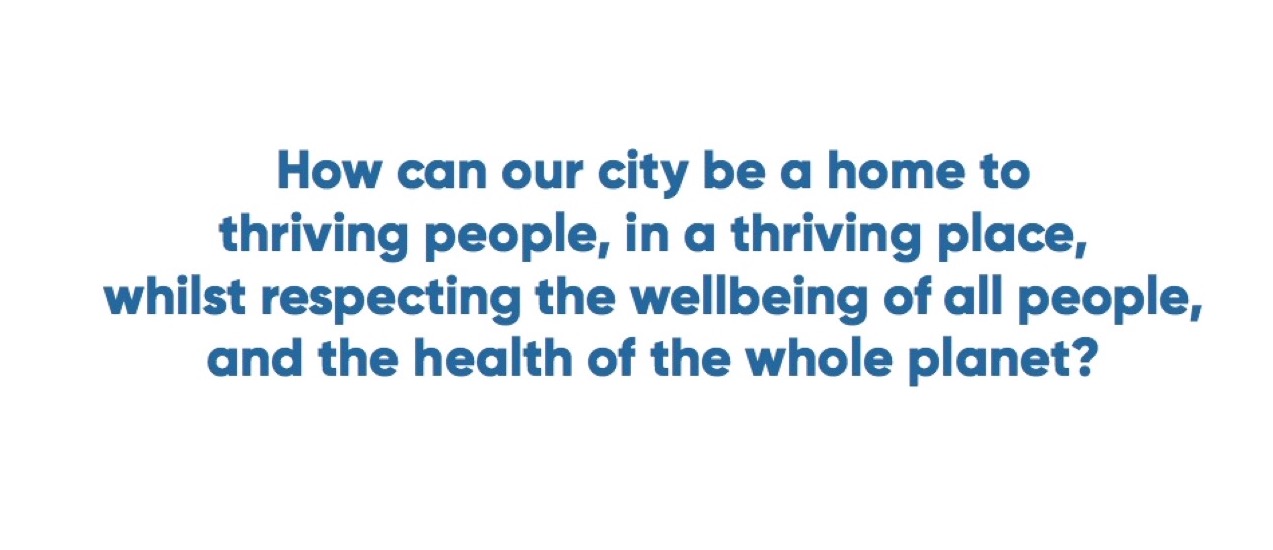
And this overarching question – which combines local aspirations with global responsibility – can be unpacked and explored further through four questions, or lenses, which together create the city portrait.

If you are interested in diving deeper into this approach, here’s a 12 minute introductory video to downscaling the Doughnut to the city, exploring how it can be turned into a tool for transformative action.
Since the publication of Amsterdam’s City Portrait, we have been contacted by people in cities, towns, villages, nations and regions, in the global North and global South, who – inspired by Amsterdam’s example – want to create downscale the Doughnut locally, as part of transforming the future of the places they live.
Today we are delighted to make this methodological guide available, with the aim of ensuring that it is as simple as possible for changemakers to downscale the Doughnut in a way that is relevant and useful for their own context.
This first version of the methodology was developed with a focus on cities in the global North, due to their responsibility to act first and fastest in transforming their social and ecological impacts. Future iterations of the methodology will be created with a focus on the context and priorities of cities in the global South, and will likewise be adapted to other scales – from neighbourhoods to nations and beyond.
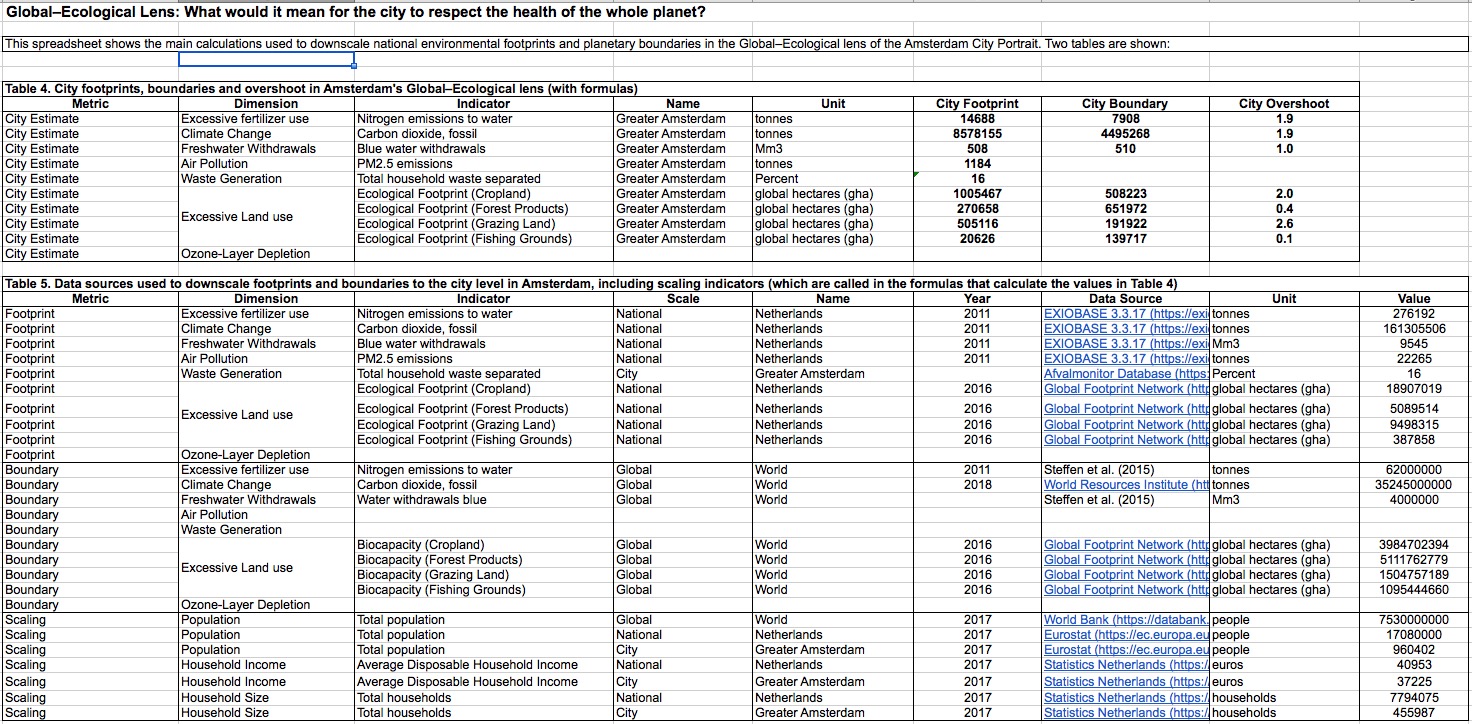
Creating City Portraits is published today along with some of the supporting worksheets used in the process, to illustrate how our team of researchers organised the information: we hope that these background documents will also be useful to others seeking to replicate and adapt the approach.
We welcome comments, suggestions and lessons learned from changemakers applying the City Portrait methodology in other places, so that we can co-create and continually improve its design and usefulness.
Cities that are members of the C40 and are interested in downscaling the Doughnut to their own context are welcome to contact the Thriving Cities Initiative (TCI) through C40’s Knowledge Hub, where the TCI will also make tools and resources available to all cities, as they are created.
In September 2020, Doughnut Economics Action Lab will (we can’t wait!) launch our website and collaborative platform, with the aim of bringing together like-minded changemakers who are putting Doughnut Economics into practice in five broad thematic areas:
- communities
- cities and places
- education and research
- business and enterprise
- government and policy
We invite you to join DEAL’s Community Platform as soon as it is launched.
DEAL will be running webinars, starting in October, for people who want to learn more about the methodology and we will hear examples from changemakers who are already putting the Doughnut into practice to remake the future of the places they live – from Amsterdam to Colombia to Costa Rica. Do join us.

This is all wonderful stuff, but I do wish that, when it is sent as an email, it fitted an email format, particularly the width. Impossible to read, and impossible to print to pdf too in an effort to make it readable.
How can I forward it to the Lord Mayor of Brisbane like this?
So sorry if you are having problems with the formatting, Harry. I recommend you just send the link to the blog to the Mayor of Brisbane and that should look fine.
https://www.kateraworth.com/2020/07/16/so-you-want-to-create-a-city-doughnut/
Great job, very inspiring. However: in ‘the book’ there’s a clear and bold framework for unleashing the creativity of the commons. In cities, this comes down to adressing the interconnected issue of affordable housing and speculation in real estate and land. In the Amsterdam example this is indicated, but not connected to an agenda. The housing coöperative provides an excellent way to work on this, but needs conditions in order to thrive. Funny thing is: Amsterdam has implemented a clear policy for this recently, but this is not yet connected to this donut-thinking.
So: how to keep a clear eye on the issues of land and real estate, which are so financialized and dominated by the neoliberal conundrum that even communities think ‘there is no alternative’? It’s not just about ‘adding the housingcoops’- it’s about adressing the fundamental issue of accessiblity, equality in the mechanisms of land and real estate.
Very good points. Affordable, secure, good quality housing is central to a workable city. When half or more of people’s incomes is demanded by landlords for insecure accommodation the economy suffers and people’s well-being is diminished. Land and housing reform is needed to sweep away a long historical injustice. Now is the time.
“… it’s about adressing the fundamental issue of accessiblity, equality in the mechanisms of land and real estate.” Yes! – especially taking the notion of time (of ownership).
It seems to me that the most destructive fact in the world today is almost a complete secret. Those who know about it mostly keep quiet, and those who talk about it are mostly ignorant. And it’s quite a simple fact.
The fact I’m referring to is that money is created as fictitious debt, and that alongside every bit of money an equal amount of real debt is also created for a borrower. Historically, this method of creating money has only ever been made legal for one reason: to increase the power and wealth of those who already have power and wealth. Whenever the method has been made legal in the past, it’s led to collapse of civilisation – just as it’s doing today.
Not only does the method create huge debt in the world and outrageous inequality, it also gives wealth and power to people who only care about getting more. Such people tend not to care about the consequences of what they do.
Money today is debt owed by a bank, which it will never pay. We think banks pay out cash, but cash is also fictitious debt – in this case, from the government. The system is a collusion between government, banks and plutocrats. Marxism only differs from capitalism in that the government monopolises completely the power and the profit which the system supplies.
The laws which make this possible may not be obviously unjust, like the laws that allowed slavery, but they are every bit as destructive: as well as creating widespread poverty and debt, they are responsible for poverty, ecological destruction and wars, and they undermine democracy. If we want to survive, we should reform and create money in a fair way.
I have asked our municipal governments to review the 12 minute video. Will continue to grow in understanding the Doughnut Economics and advocate for change
Perfect timing! I am using “Donut Economics” as my inspiration for an assignment and was halfway through pulling the data for Australia to create one. With this I can hopefully repeat the exercise down to a state and eventually city level (although maybe not for the assignment 🙂 )
Thank you!
Who is leading up the efforts in Philadelphia? Need to raise awareness here locally about donut economics. And local and state politics lately around Philly can only be described as a complete failure of government and our federal system of ‘democracy by and for the people’.
Thank you for your courage, thought and conviction. The donut theory fills me with hope everyday.
I so wish that the Doughnut be more informed about Modern Monetary Theory, and how we can Reclaim the State for the benefit and well-being of humanity
I am wondering if the Donut group knows about common good economics, which has already been used to transform dozens of towns and municipalities, companies and even a few cities. You can find out more on ecogood.org. There is also the “transition town movement”, which has achieved quite a bit. What I wish, is that all of the “authors” of the various approaches (donut, transition town, commons, common good economics), would collaborate and reduce the branding. Imagine how little neoliberal economics would have achieved if it had fragemented into dozens of competing models!
Hi, Will this report be available in a hard copy format in the future?
Hi Leonie, no we won’t be publishing it as hard copy, but you can get it printed out A3 format.
These are such exciting developments. I am based in Paris where many new initiatives are taking hold, particularly following COVID. I look forward to exploring how this framework might be used to support initiatives here and across the country which has recently seen a wave of environmental parties being elected in key cities.
Hi Kate – I’ve been using the Doughnut as a conceptual lead-in for the work we do for some time, so it was great to see the launch of the city-scale Doughnut recently, because that was the missing piece of the puzzle. I’m tweaking it slightly so it’s generally applicable to all places, including cities. We are launching a consultation on how to adapt our TOMs social value measurement framework to support a green and fair recovery and rebuild from COVID; your global/local social/ecological pairings are a perfect anchor for this discussion. We work a lot in the local government sector in the UK and I’m keen to get our customers and stakeholders to build the Doughnut into their thinking. Best wishes, Nathan
thank you for sharing and thank you to consider the portrait a joint effort.
I would like to inform you I’m downscaling it even more to a portrait for businesses and using it to help companies to move within the doughnut and help them to make a better world for everybody and everything.
if you would like to be updated on the progress, please let me know. If I misunderstood the joint effort concept and am not allowed to use it, please let me know too.
my website is given but in the process of being build and not yet in English.
Thanks for letting us know, Saskia.
At Doughnut Economics Action Lab we are working on a methodology for applying the Doughnut to the world of business and enterprise, and we invite you to join DEAL’s community as soon as we launch in late September.
Business and Enterprise is one of the five focus areas we are working on, and there you will meet other practitioners and find our existing resources and guidance on downscaling for business.
To answer your question – yes you are allowed to work with this framework but we have very clear conditions of its use and application, most especially in the context of business since this is a field it which it could most easily be misused or misapplied.
Please do join us @DoughnutEcon on Twitter, or at our website http://www.doughnuteconomics.org – see you there!
Hi Kate,
I am working with a university to look at how we can adopt/adapt the methodology to look at application to ocean infrastructure developments, partly to help inform the next phase of research in new technology, but also with the aim to shape the direction of the ‘blue economy’ from being an extract only model.
I’m digging into the resilience (permaculture Mollison/Holmgren) and systems (Meadows et al.) philosophies to underpin this. As well as considering how to rephrase the questions to apply in this context. ie there are not many people on much ocean infrastructure, but there’s could be opportunity for it to thrive within its environment which would lessen impacts elsewhere.
Yet, I recognise that this is taking your model in a new direction. Can you please explain what the conditions of the model’s use and application are?
Also, cities are systems, and so are businesses. Businesses build infrastructure. Do you think the application of the model yields more by applying it to the infrastructure system or the people/money system? I’m just thinking that there is a historical bias effect that could result in one becoming more familiar in time and so becoming an embedded approach.
Thanks
Rebecca